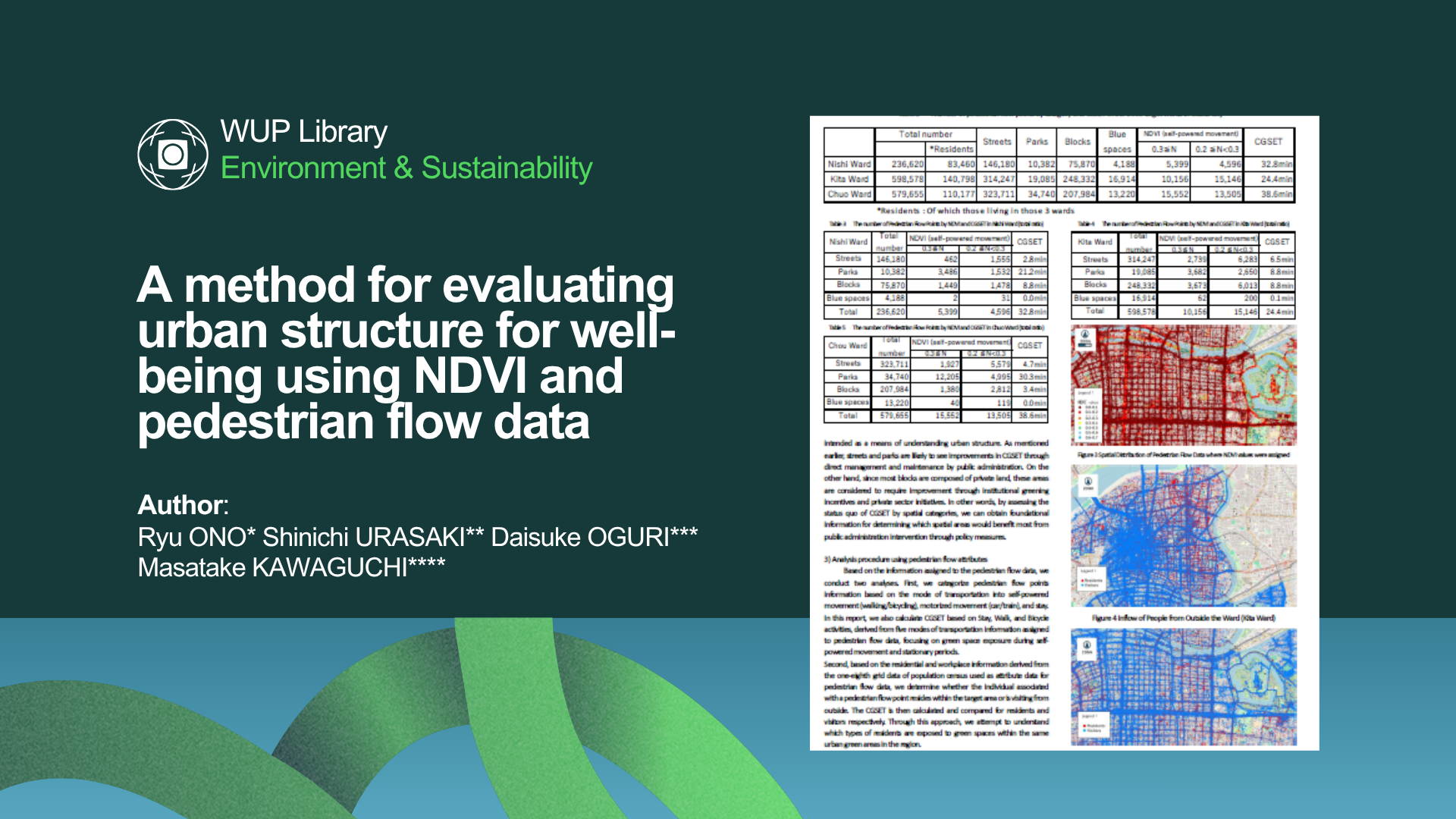
This research introduces an innovative framework for understanding how urban greenery influences human well-being by combining satellite-derived vegetation data (NDVI) with large-scale pedestrian flow analysis. Moving beyond traditional measurements of park size or canopy coverage, the study develops the Cumulative Green Spaces Exposure Time (CGSET) indicator, which evaluates how long people are exposed to greenery through their everyday mobility patterns. Applied across three central wards of Osaka, Japan, the methodology reveals how streets, parks, and even intra-block green spaces contribute differently to urban well-being.
The report demonstrates how geospatial technologies and mobility data can uncover hidden inequalities in green space exposure and identify priority areas for urban intervention. By mapping locations with moderate vegetation levels—where strategic greening efforts could significantly improve daily exposure—the study provides actionable insights for planners and policymakers seeking more effective and human-centered urban green strategies. The findings also highlight how residents and visitors interact differently with urban nature, emphasizing the role of parks, walkability, and accessible greenery in supporting healthier urban lifestyles.
Rather than treating green infrastructure as a static quantity, the publication reframes it as a lived urban experience shaped by movement, accessibility, and spatial structure. It ultimately presents CGSET as a practical planning tool for guiding policy, prioritizing greening investments, and designing cities where nature becomes an integral part of everyday life.
Download the full article by clicking here!
¿New here?
Start your 30-day free trial and explore all the benefits of World Urban Parks membership
Already a member? Just log in to your account.

Want to discover how data, mobility analysis, and green infrastructure can reshape healthier and more resilient cities?
Download A Method for Evaluating Urban Structure for Well-Being Using NDVI and Pedestrian Flow Data and explore innovative methodologies, spatial analysis tools, and urban planning insights that help cities better understand the relationship between people, movement, and nature. Access to the full document is exclusive to World Urban Parks members. If you’re not yet part of our community, we invite you to join today and gain access to global research, professional resources, and exclusive learning opportunities.