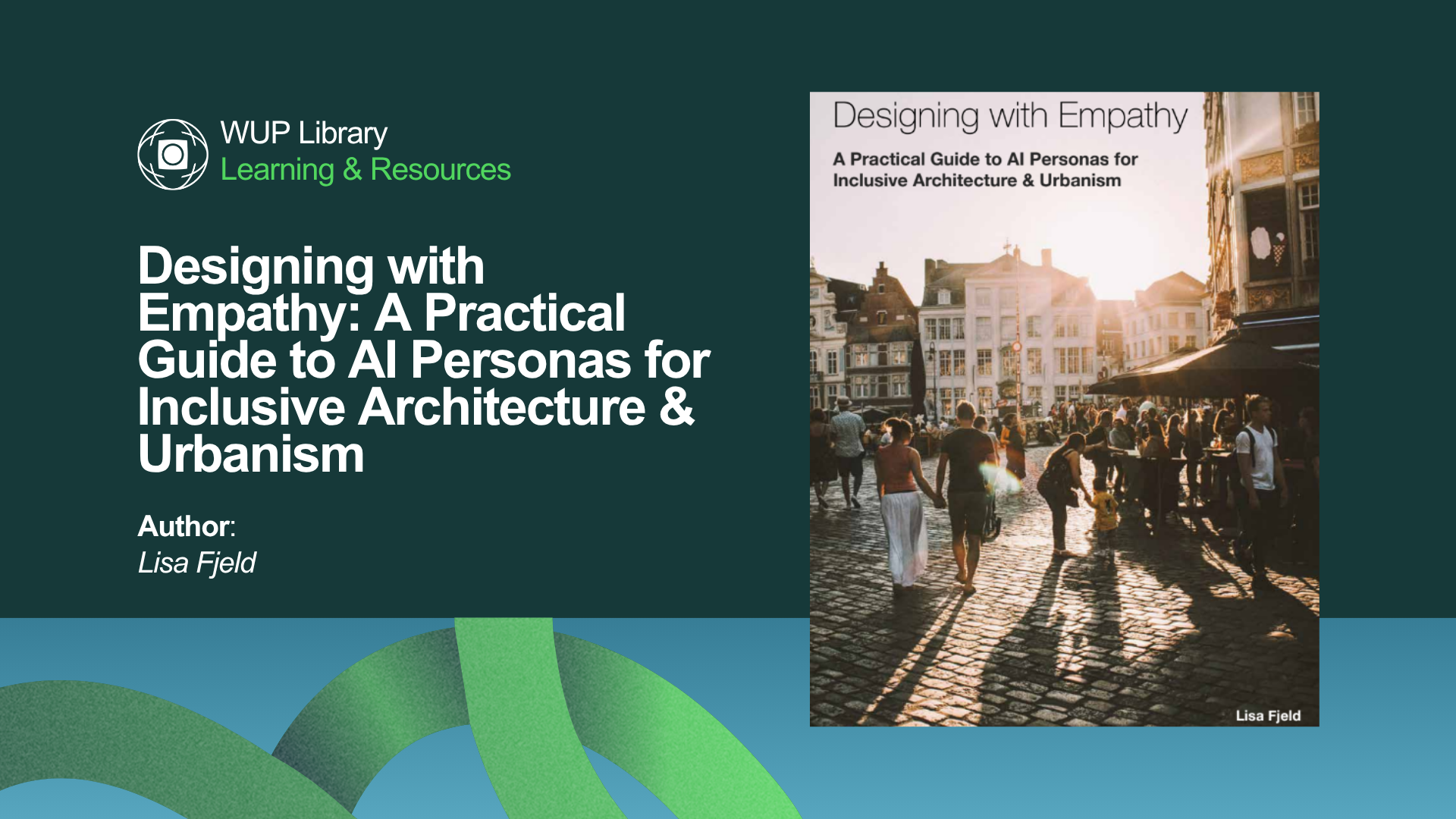
Can a machine help us design for the people a plan usually forgets? This guide makes an honest case that it can — as long as it never decides alone.
When a park or plaza is first sketched, whose experience is actually in the room? Workshops and surveys are essential, but they tend to reach the people with the time, language, and confidence to show up. The child, the recent migrant, the elder, the wheelchair user — their daily reality often arrives too late, after the concept has already hardened.
Lisa Fjeld’s guide is built to close that gap. Its proposal will feel intriguing and slightly uncomfortable in equal measure: use AI-generated personas — data-informed profiles built from demographics, mobility patterns, cultural context, and wellbeing indicators — to bring lived experience into the earliest design stages, when intentions are still soft and trajectories can still change.
What earns the guide our attention isn’t the technology. It’s the discipline around it. Fjeld refuses to sell AI as a shortcut: an entire chapter is devoted to bias and trust, anchored in three safeguards worth adopting wholesale — curate data with intention, audit for who’s missing, and always keep humans in the loop. Her golden rule should travel far in our sector: AI personas enrich community participation; they never replace it.
From there it gets practical. A five-phase workflow, a workshop method almost any team could run tomorrow (hand each member a persona and walk the site plan as that person — the unsafe crossing, the dark corner, the impossible ramp all surface early), and a strong bank of global cases: Ghent, Seoul, La Paz, Superkilen, Bryant Park, Vienna, Finland’s Housing First.
Why it matters to our community. Its terrain — parks, mobility, public space as social infrastructure — is ours. But its real contribution is a mature, ethical vocabulary for a conversation already at our door: how do we bring AI into public-space design without surrendering rigor, ethics, or the community’s genuine voice? That’s a professional-development need right now, not a future one.
The idea worth carrying: empathy is not a soft value; it’s a method — and used with judgment, new tools can help make visible exactly the people our designs tend to overlook.
Download the full article here
¿New here?
Start your 30-day free trial and explore all the benefits of World Urban Parks membership
Already a member? Just log in to your account.

Keep the conversation going. Subscribe to World Urban Parks and join a global community committed to creating better parks and public spaces for everyone.