The number that frames everything: globally, only 44% of urban residents live near an open public space — and in low- and middle-income countries that figure drops to 30%. As motorization, privatization, and sprawl erase child-friendly areas, a generation is growing up with fewer safe places to play, learn, and simply be children.
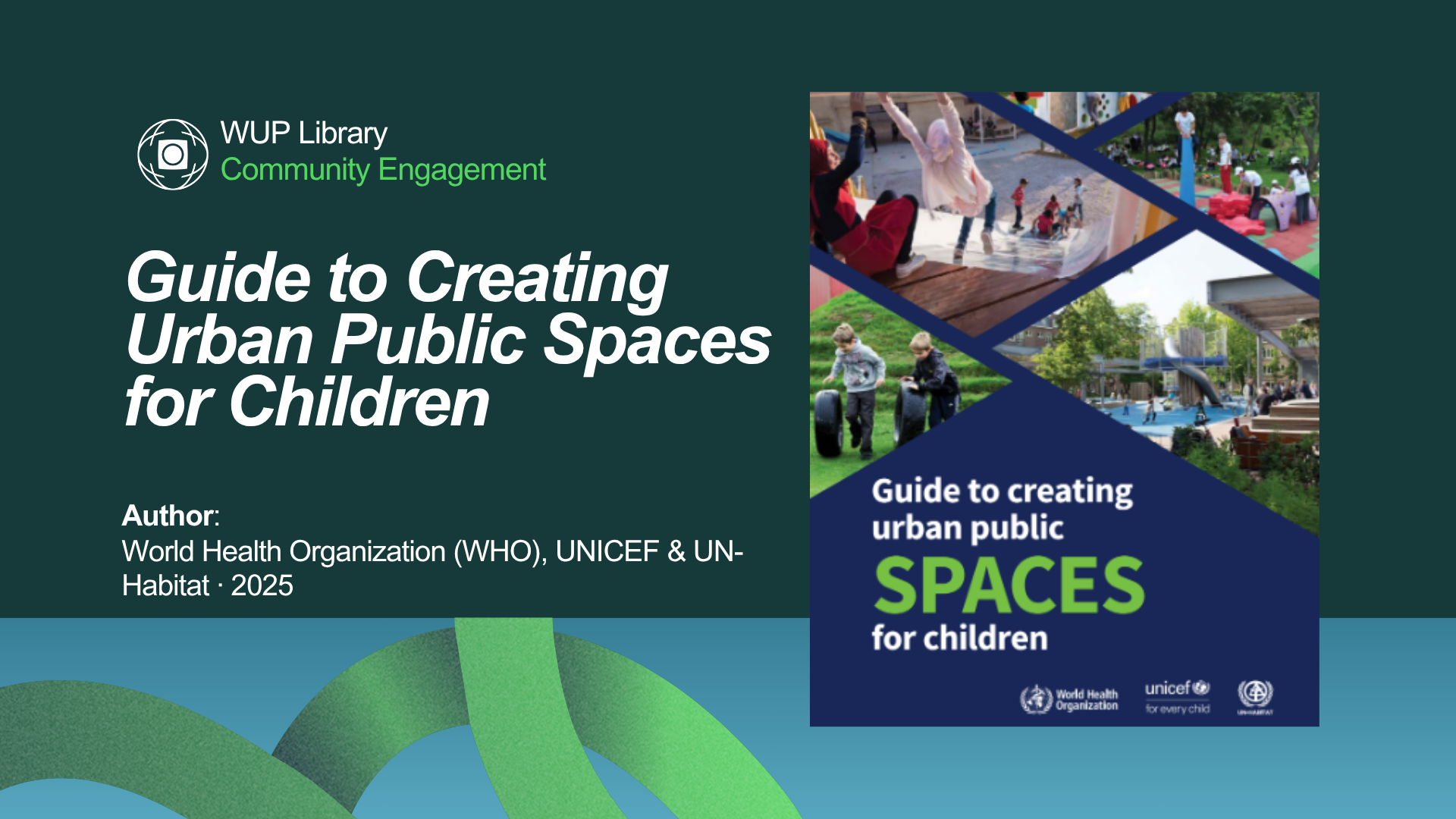
What it is. SPACES is a joint framework from three UN agencies — WHO, UNICEF, and UN-Habitat — created to guide the design and improvement of urban public spaces for children. Its foundation is not preference but right: Article 31 of the UN Convention on the Rights of the Child guarantees every child’s right to rest, play, and take part in cultural life. This guide translates that right into practical guidance for the people who plan, build, fund, and maintain public space.
The core idea worth holding onto. The document makes a claim that reframes how we value our work: well-designed public spaces regularly used by children are one of the strongest indicators of a livable city — not only for children, but for everyone. Design for the eight-year-old and the eighty-year-old benefits too. Children are, in effect, a diagnostic lens for the quality of the entire public realm.
The framework. The heart of the guide is the SPACES acronym — six principles that together define a quality space for children:
- Safety and protection
- Play, recreation and developmental needs
- Access where need is greatest
- Child health and well-being
- Equity and inclusion
- Sustainability and resilience
Around these, the guide adds a genuinely useful analytical structure: three scales (housing, neighbourhood, city), four categories of space, and three contexts — planned, informal, and crisis/resilience-building. That last distinction matters enormously for Latin America, where so much of the real work happens in informal settlements rather than master-planned developments.
Download the full article here 👇
¿New here?
Start your 30-day free trial and explore all the benefits of World Urban Parks membership
Already a member? Just log in to your account.

A concept that will resonate with our sector. SPACES gives serious weight to what it calls liminal spaces — the leftover, in-between, “forgotten” places children naturally claim: dead-end streets, vacant lots, the gap between buildings, the space under an overpass. Where formal parks are scarce, these improvised spaces become essential. The guide’s argument is that planners should recognize, protect, and improve them rather than erase them — a direct challenge to the instinct to treat unprogrammed space as wasted space.
A city that works for children works for everyone. Access exclusive WUP resources and lead the change in your community. Join the WUP Membership