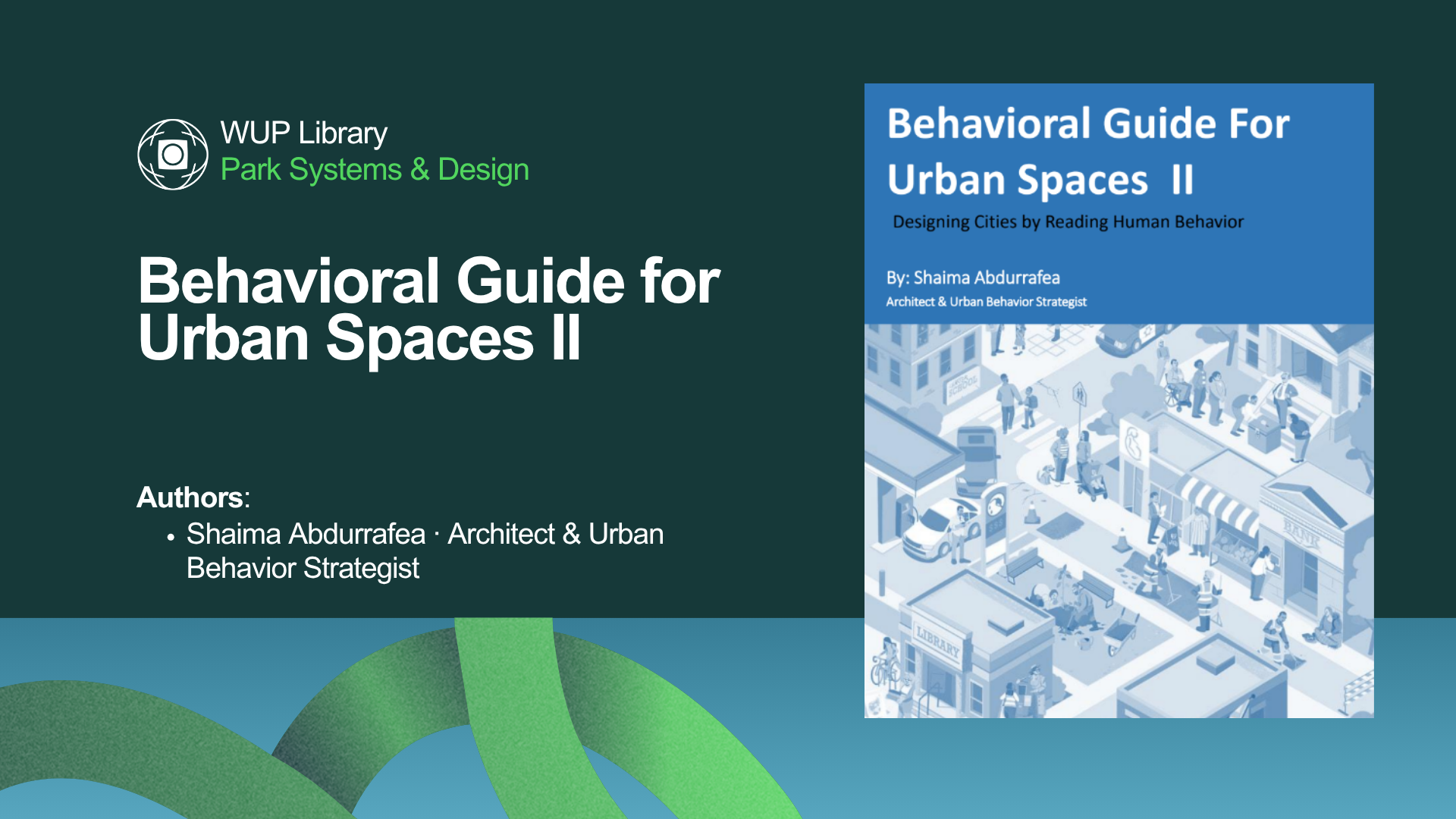
The conversation continues — and this time, it goes quieter, deeper, and closer to the ground.
The first guide taught us to read the loud, visible behaviors: how people walk, sit, wait, and belong. This second volume tunes the ear to the subtle signals — the ones that shape how cities function, adapt, and endure long after the ribbon is cut. It’s not about adding complexity. It’s about sharpening awareness.
What it is. A companion framework of 10 new behaviors that reveal the hidden dynamics of public space — the informal systems, unmet needs, and quiet negotiations that formal plans rarely capture. Together with the first guide, it forms a complete behavior-based approach to urban design.
Why it matters. The clearest feedback a city gives is rarely dramatic. It’s a worn shortcut across the grass, a bag saved on a bench, a body drifting toward shade at noon. Learn to read these, and you design with intention instead of assumption.
The 10 behaviors it teaches you to notice:
- Lingering — when a space earns the right to make people stay
- Shortcut & Desire Line — the city as people actually use it
- Stopping & Pausing — where movement briefly rests
- Territorial Claiming — small acts of control in shared space
- Observation & Spectatorship — being present without participating
- Care & Maintenance — attachment expressed through action
- Shadow-Seeking — people don’t follow paths, they follow comfort
- Speed Change — pace is a response, not a personality
- Edge Use — people feel safer at the edges than in the spotlight
- Informal Seating — if it can be sat on, it will be
Who it’s for. Planners, designers, park managers, and decision-makers who want to move past reading the obvious — and start recognizing the informal systems that quietly keep public space alive.
Download the full article here 👇
¿New here?
Start your 30-day free trial and explore all the benefits of World Urban Parks membership
Already a member? Just log in to your account.

The premise holds from the first page to the last: cities are always communicating through human behavior. The more accurately we read the signal, the more intelligently we design.
Keep the conversation global. Reading cities through behavior is a practice that grows stronger in community. Connect with World Urban Parks — the international network linking the people who plan, build, and steward public space around the world. Take these ideas beyond the page and into a worldwide community of practice — join World Urban Parks.